The wider war behind this night.
These ships served in the Second World War (1939–1945). Britain fought as part of the Allied coalition; Nazi Germany belonged to the opposing Axis alliance. Operation Tunnel was a Royal Navy campaign against German coastal shipping.
The German ships in this action belonged to the Kriegsmarine, Nazi Germany’s navy. Their surface torpedo boats protected the route of Münsterland and attacked the British force off northern Brittany. Understanding the opposing forces makes the loss, rescue and island remembrance part of a much larger wartime story.
The Allied and Axis alliances · US Holocaust Memorial Museum ↗Admiralty Battle Summary No. 31 ↗A short introduction and naval glossaryTwo ships for a world at war.
Charybdis was a Dido-class cruiser, built at Cammell Laird in Birkenhead and commissioned in November 1941. Limbourne was a smaller Hunt Type III escort destroyer, built on the Clyde and entering service in October 1942. Their different sizes, armaments and duties shaped the experience of the people aboard.
Charybdis service chronology ↗Ordered on 4 July 1940, Limbourne emerged from a period when Britain urgently needed escorts. Alexander Stephen and Sons laid her keel in Glasgow on 8 April 1941 and launched her on 12 May 1942. She entered service that October. Dagenham had adopted the ship after its Warship Week savings campaign, giving a community ashore a connection to a company at sea.
Naval-History: HMS Limbourne service history ↗Her pennant number was L57. As a Hunt Type III, she combined the work of an escort with a surface-attack capability. Four 4-inch guns sat in two twin mountings, one forward and one aft; a twin bank of 21-inch torpedo tubes distinguished the Type III arrangement. Anti-aircraft and anti-submarine equipment addressed the other threats an escort might face.
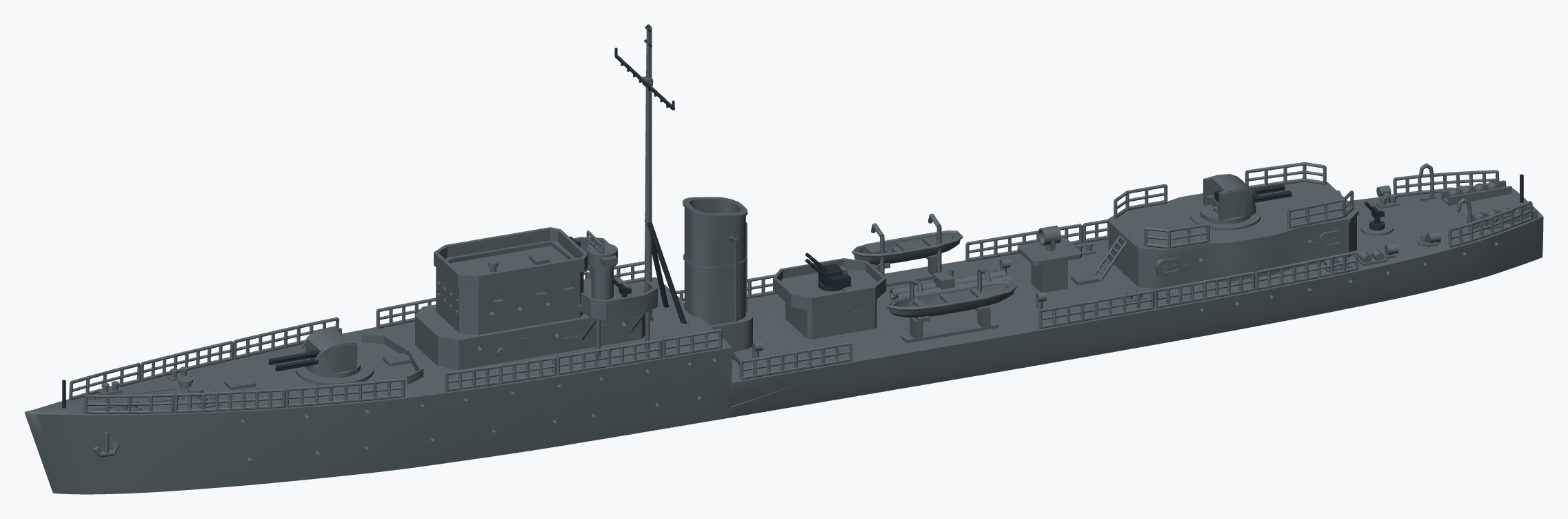
Uboat.net: Hunt (Type III) class ↗An original black-and-white view of Limbourne from the port bow. Her pennant L57, main guns, bridge, mast and camouflage boundaries can be seen. The exposure date and location have not been confirmed.
In this photograph, follow the ship from her forward twin-gun mounting to the bridge and tall mast, then aft past the funnel and boats. The visible paint boundaries are photographic evidence; the original colours and a precise final-day configuration cannot be recovered from the tones alone.
Different duties at sea.
Charybdis’s service included Malta operations, Operation Pedestal, the North African landings and the Salerno operations. Her company brought Mediterranean experience to the final Channel sortie. Her own service history follows those earlier journeys.
By December 1942, Limbourne had joined the 15th Destroyer Flotilla at Plymouth. Her work included convoys in the Channel, Western Approaches and on the Gibraltar route, followed by anti-submarine work in the Bay of Biscay and offensive Channel sweeps. A damaged propeller took her to Portsmouth for repairs in March 1943. She sustained slight damage in the action of 3–4 October.
Naval-History: HMS Limbourne service history ↗That service depended on far more than the guns visible above deck. Lookouts and signalmen watched and communicated. Engineering ratings kept the steam plant working. Gun and torpedo teams maintained weapons. Cooks, stewards, medical personnel and many others kept a crowded ship functioning. Watches continued through darkness, weather and fatigue.
The name “Tunnel” referred to repeated British operations against German coastal shipping. Limbourne’s final sortie was one of these sweeps. It is often remembered as the Battle of Sept-Îles.
Admiralty Battle Summary No. 31 ↗Many roles across two ships.
Explore what naval titles tell us, and where an individual’s story needs more evidence.
Skilled work behind the steam.
Stokers tended oil-fired machinery and the systems that kept a ship moving. Boiler cleaning, burners and machinery temperatures demanded practical skill. Artificers were technical specialists: engine-room, electrical and ordnance titles identify different branches and should not be treated as interchangeable.
General naval role. The stoker examples come from Harold Siddall’s service in HMS Revenge, not a record of Limbourne’s engineering watches.
Firsthand engineering account · Harold J. Siddall ↗See 140 names across both ships in this part of the recordThese groups are reading aids for the incomplete memorial. They are not a final-night personnel breakdown.
 Related photograph
The work behind a warship.
Aboard HMS Belfast, IWM curator Rob Rumble explains the bridge, guns, machinery, galley and sick bay. A companion view of naval roles across wartime ships.
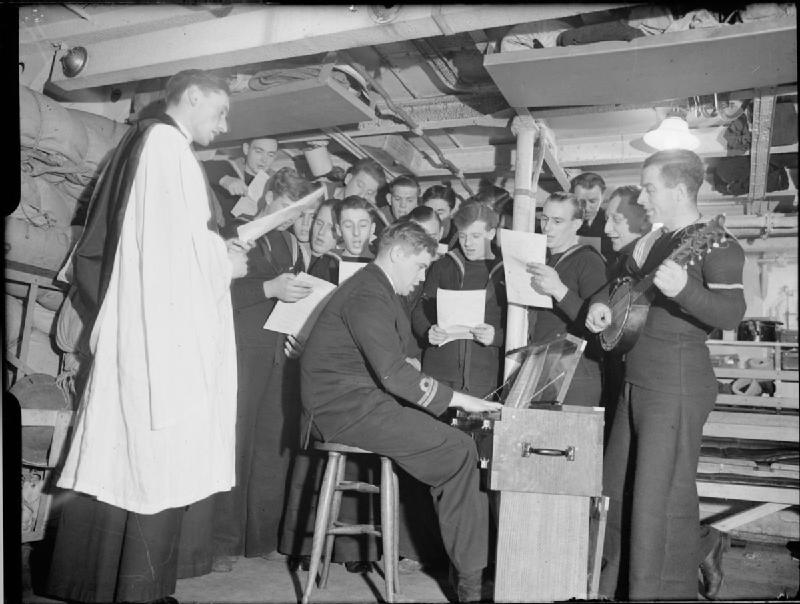
IWM’s film visits HMS Belfast. Her spaces and crew numbers must not be treated as those of Charybdis or Limbourne. The related photograph shows sailors aboard Stevenstone.
Imperial War Museums · Published 20 May 2026
The external video player loads only when selected. Some networks restrict video; the written history can be explored independently.
 Related photograph
The Mediterranean war, on film.
A 1942 newsreel of the Malta convoy battles, showing gun crews, survivors and life on deck. A view of the campaign in which Charybdis served.
Campaign footage from 1942. Not film of the October 1943 attack; people and ships in individual shots are not identified here.
British Pathé · Published 13 April 2014
The external video player loads only when selected. Some networks restrict video; the written history can be explored independently.
The last departure.
At about 19:00, Force 28 left Plymouth. The cruiser Charybdis sailed with Grenville, Rocket, Limbourne, Talybont, Stevenstone and Wensleydale. Stevenstone had replaced Melbreak, a change that some later accounts miss. Walter John Phipps commanded Limbourne.
The operation sought enemy shipping off northern Brittany. The blockade runner Münsterland had left Brest with an escort, while German torpedo boats screened its route. German coastal radar detected the British approach. In the dark sea near Sept-Îles, both sides were trying to locate and understand the other.
Admiralty Battle Summary No. 31 ↗Île aux Moines and Île Bono in the Sept-Îles archipelago off northern Brittany. A modern view of the coastal setting near the 1943 action.
A postwar British intelligence report, drawing on captured German records, describes five torpedo boats in the outer screen under Franz Kohlauf. It reports that four boats each launched six torpedoes. These were surface warships carrying out a coordinated torpedo attack, not a submarine attack.
Naval Intelligence report from captured German records ↗Charybdis and the command of Force 28.
Explore Charybdis’s history and 3D model →Charybdis was the cruiser leading Force 28. She was a Dido-class ship, much larger than Limbourne, and Captain George Voelcker commanded the force from her. Her presence brought cruiser armament to an operation otherwise carried out by destroyers. The ships had different capabilities and had to work together in a difficult night action.
HMS Charybdis (88), the Dido-class cruiser lost alongside Limbourne, underway in February 1943.
Charybdis had served in Malta convoy operations, Operation Pedestal, the North African landings and the Salerno operations. Her company had already experienced demanding wartime service before the Channel sweep. Her service chronology follows that wider career. But this operation required a shared understanding of contacts, manoeuvres and command. The subsequent Admiralty account describes confused information and the difficulty of combining ships with different experience of these operations.
When Charybdis was torpedoed, the force lost both its leading ship and its commander’s ability to direct the action. Limbourne’s senior officer was then incapacitated by the hit on his own ship. Those two blows help explain why the rescue story includes a period of uncertainty and regrouping, as well as the courage of the return.
Admiralty Battle Summary No. 31 ↗Follow Charybdis in the final-night timelineFrom the torpedo hits
to the final sinking.
Both ships were struck within minutes. Limbourne’s remaining hull stayed afloat much longer.
From the reported torpedo hits to the reported sinking.
Her remaining hull stayed afloat through rescue and an unsuccessful tow before she was scuttled.
Approximate intervals calculated from the British Battle Summary’s reported times. Other accounts differ. Bars do not show when individual men left a ship or were rescued. Read the account ↗
Seven minutes of disaster.
Limbourne intercepted German speech at 01:03, with further manoeuvring orders heard later. At 01:35, Charybdis reported a radar contact. But a contact on a screen or a fragment of intercepted speech did not amount to a shared, accurate tactical picture.
The torpedoes arrived before the British force could prevent the attack. Charybdis was struck at about 01:45. The Battle Summary describes two torpedo hits, loss of power and a severe list. Hundreds of men aboard the cruiser suddenly faced the prospect of abandoning ship into the dark sea. Around 01:52, Limbourne was hit forward. The explosion destroyed her bow, killed and injured men, and damaged the systems on which command and movement depended.
Limbourne did not sink immediately after the hit. Her remaining hull stayed afloat for hours. Rescue, damage control and attempted recovery came before the decision to scuttle her.
The hit on Limbourne is generally attributed to the German torpedo boat T22. The British Battle Summary places the strikes only minutes apart. Those timings are reported historical times, not a modern reconstruction precise to the second.
Admiralty Battle Summary No. 31 ↗A ship still afloat.
The forward boiler-room bulkhead held. That watertight boundary helped prevent the damage from immediately taking the rest of the ship down. But the loss of the bow, damaged steering and communications, and wounded men made this an emergency of extraordinary difficulty.
Phipps and the first lieutenant had been concussed. The Battle Summary describes Sub-Lieutenant Cunliffe-Owen taking charge. With signalling equipment lost, he went by motor boat to Talybont to explain the ship’s condition. The accompanying ship report describes the difficult task of freeing wounded men from the wreckage of the Wireless Office and forward superstructure. Men who moments before had been fighting stations now had to manage flooding, care for shipmates and work out how to survive.
Charybdis sank at about 02:30. The other destroyers regrouped, turned back at 03:15 and reached Limbourne around 03:46. The search was for people from both ships. The Battle Summary records 107 survivors rescued from Charybdis, a separate total from the men taken off Limbourne. Returning meant accepting that the enemy might still be nearby. In darkness, with injured men and a badly damaged hull, transferring the crew was itself dangerous work.
Admiralty Battle Summary No. 31 ↗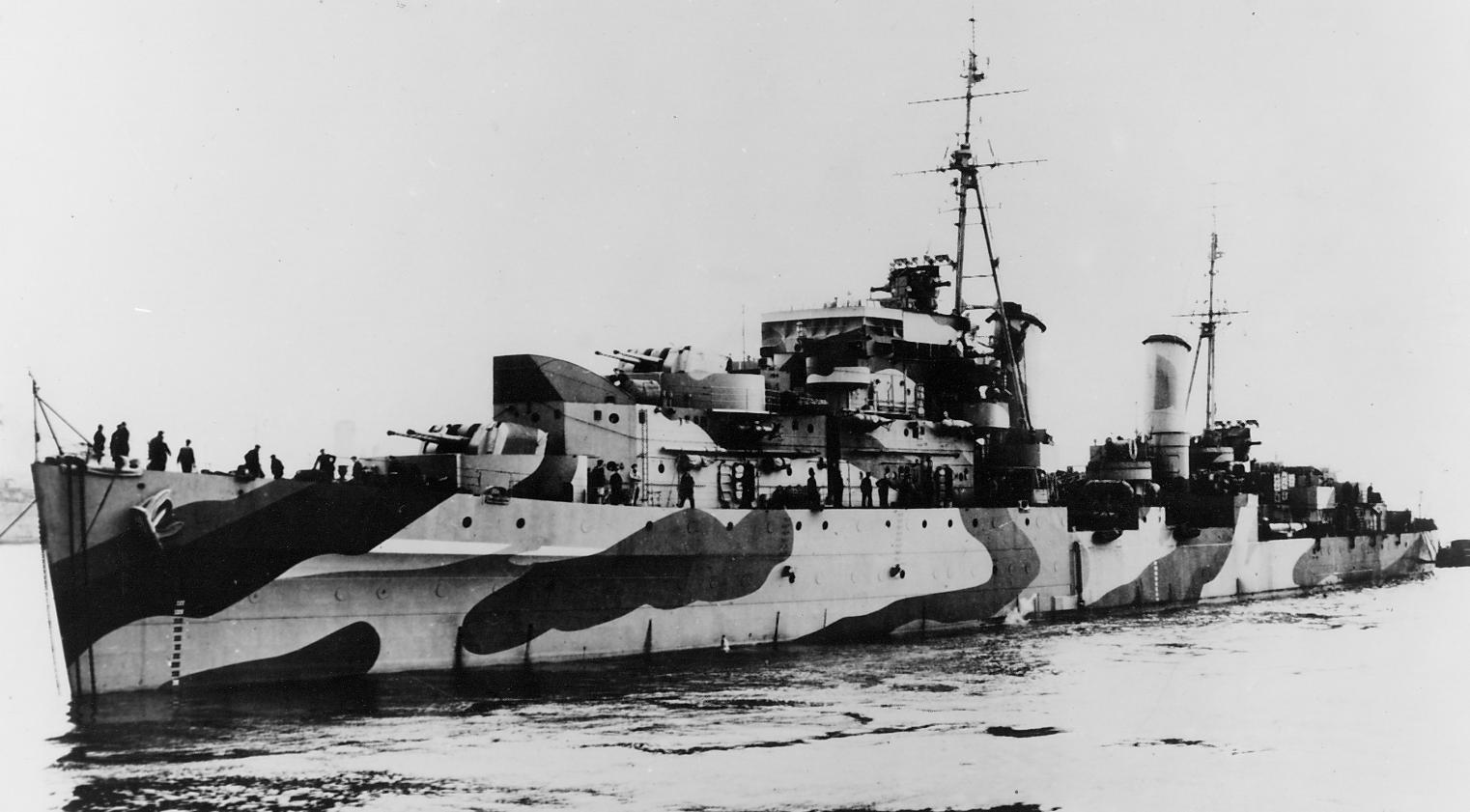 Related photograph
Hear John Eskdale’s account.
John Eskdale recounts surviving Charybdis before continuing his wartime service in the Far East. The Veterans’ Foundation introduces his later connection with the Royal Marines and the memories he shares with a younger generation.
A retrospective interview with a Charybdis survivor. Contains recollections of drowning and loss. The photograph shows his ship, not the interview.
Veterans' Foundation / YouTube · Published 4 November 2025
The external video player loads only when selected. Some networks restrict video; the written history can be explored independently.
The decision to scuttle Limbourne.
Talybont tried to take Limbourne in tow. The attempt failed. The missing bow and the ship’s damaged condition made recovery unworkable; at 05:02 a signal reported the failure to tow her. Once the surviving company had been taken off, the order was to sink the wrecked ship.
Talybont and Rocket carried out the scuttling. The British Battle Summary records the final sinking at 06:40. Other summaries differ about which weapons completed it and the exact sequence. The central fact is clear: after a torpedo crippled Limbourne and efforts to save her failed, British ships deliberately sank her.
The rescue force returned to Plymouth at about 10:00. The men brought back carried the physical and emotional consequences of a night in which two ships had been lost and many shipmates had not returned.
Admiralty Battle Summary No. 31 ↗The lives behind the loss.
A ship’s company is not a single number. The names include men from different branches of naval service, with different jobs, families and futures. Published accounts also identify a party of American soldiers aboard Limbourne, an aspect of the loss that short summaries can overlook.
Casualty and survivor totals vary between sources. The familiar summary of 42 deaths and 100 survivors does not, by itself, settle who was aboard or how attached personnel and later deaths were counted. This project therefore records names with their evidence and keeps unresolved differences visible.
Naval-History: HMS Limbourne service history ↗David Allen’s HMS Wensleydale history: American observers ↗The memorial is a growing record, not a completed final-night muster. Descendants can contribute names, accounts and references. A family memory can open a line of research; a service record, letter or contemporary report can help connect that memory to the historical record.
Charybdis’s casualty entries and named survivors are recorded separately within the same memorial. The source-entry counts are not reconciled ship totals. Both companies are remembered through individual records that can grow as further evidence is contributed.
Meet and remember the crewRemembered on the islands.
In the weeks after the loss, bodies from the disaster reached the Channel Islands. In occupied Guernsey, funerals with military honours drew thousands of islanders. Their attendance and wreaths made the mourning a public expression of respect for the dead and loyalty to Britain.
A service-history account records nineteen burials at Le Foulon on 17 November 1943. The Royal Court reports twenty-one bodies brought ashore on Guernsey overall. These are different counts, and should not be turned into a claim that all twenty-one were buried at that single funeral.
Royal Court of Guernsey: the ships and their remembrance ↗Charybdis service history: the 17 November funeral ↗The war cemetery in Howard Davis Park, St Helier, Jersey, where men from HMS Charybdis are buried. Photographed in 2011.
Charybdis graves in Jersey form another part of this geography of remembrance. The modern photograph above shows Howard Davis Park in St Helier, not the Guernsey funeral. Families, island communities and naval associations have continued to preserve these connections.
On 24 September 2023, Guernsey marked the eightieth anniversary with a service at Le Foulon and wreath laying. Remembrance continues long after the last eyewitnesses are able to tell their stories.
Government House: the 80th anniversary service ↗Explore Charybdis and remembrance