Launched on the Mersey
Built by Cammell Laird at Birkenhead, Charybdis was launched in 1940 and commissioned on 15 November 1941. Her four twin 4.5-inch mountings distinguished her from the intended main armament of the Dido design.
Explore the ship.
Discover the lives within it.
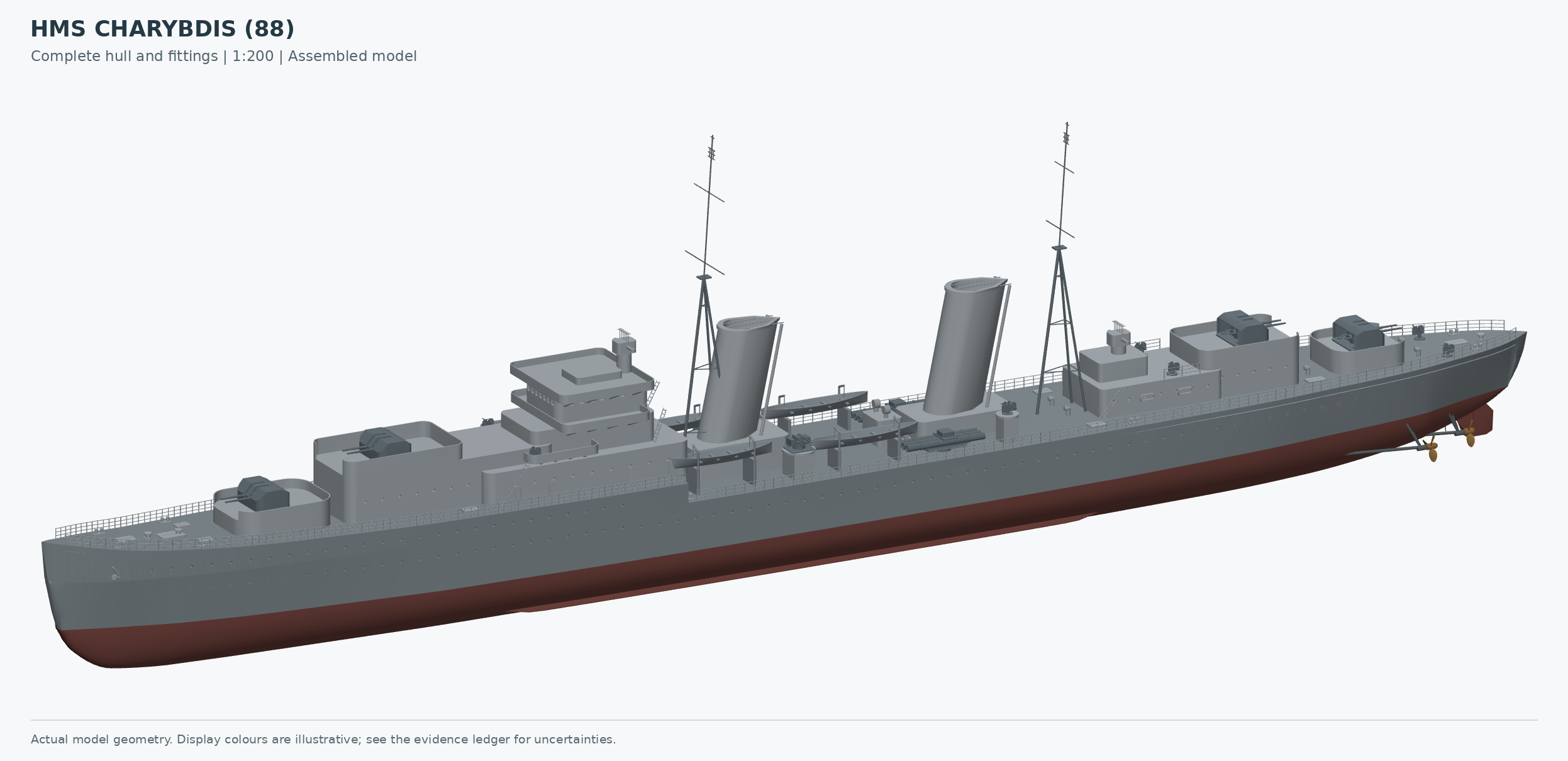
Explore above and below the waterline.
Short, self-paced routes through the ship and its people.
An interpretive reconstruction of the intact ship, with four twin 4.5-inch main mountings. Underwater lines, small fittings and exact late radar and light-AA details remain uncertain. Neutral colours are not a verified camouflage scheme. The written guide remains available without 3D.
HMS Charybdis (88), the Dido-class cruiser lost alongside Limbourne, underway in February 1943.
Built by Cammell Laird at Birkenhead, Charybdis was launched in 1940 and commissioned on 15 November 1941. Her four twin 4.5-inch mountings distinguished her from the intended main armament of the Dido design.
Charybdis took part in operations supporting Malta, including fighter deliveries and convoy protection. During Operation Pedestal in August, she screened the damaged carrier Indomitable.
Her service included the North African landings and the Salerno operations. Convoy and fleet work repeatedly took her company into danger before the move to Channel operations.
Captain George Voelcker led the force from Charybdis as it sailed from Plymouth with six destroyers. The operation sought German coastal shipping off northern Brittany.
HMS Charybdis screens the burning aircraft carrier HMS Indomitable during Operation Pedestal, 12 August 1942.
At about 01:45, Charybdis was struck by torpedoes. The Admiralty account describes two hits, flooding in vital machinery spaces, loss of power and a severe list. Men had to move from fighting the ship to abandoning her in darkness.
The cruiser sank at about 02:30. Limbourne, hit forward minutes after Charybdis, was still afloat. The remaining destroyers regrouped and turned back to search. The account records 107 people rescued from Charybdis; this is separate from the men taken off Limbourne.
Hundreds of Charybdis’s company died. Published totals differ, and a casualty roll cannot tell every part of the story: the wounded, those who survived, and the families waiting for news all belong in this history.
The Admiralty action account and associated reports ↗Follow the attack and rescueThe register includes 460 Charybdis entries transcribed from the published combined Roll of Honour, alongside separately sourced survivor records. That is the number of entries in this source, not a reconciled final casualty total or a complete list of everyone aboard.
Survivor David “Rocky” Royle’s memoir, Gordon Smith’s research into his father George Charles William Smith, and later interviews with survivors connect the official account with lived experience. Their original accounts are collected in the media archive.
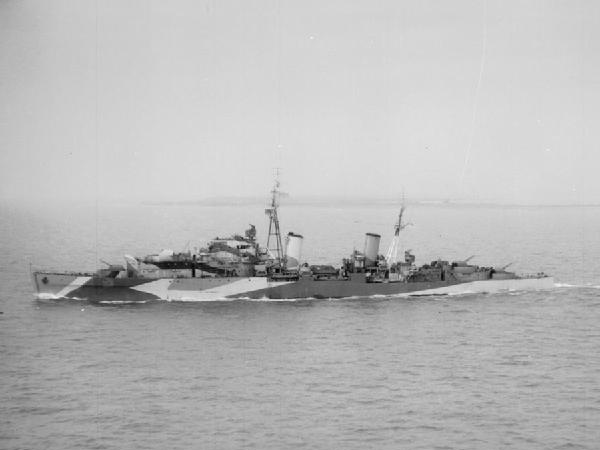 Related photograph
Underwater footage of Charybdis’s wreck, filmed in 2011 and published by FinnborgBraga.
Modern wreck footage. The related wartime photograph shows the intact ship; neither is a recording of the sinking.
FinnborgBraga · Published 2 May 2012
The external video player loads only when selected. Some networks restrict video; the written history can be explored independently.
After the loss, bodies reached the Channel Islands. The Royal Court records twenty-one brought ashore on Guernsey; nineteen burials at Le Foulon on 17 November are recorded separately. Thousands of islanders attended the wartime funerals.
The annual commemorations, relatives’ visits and graves in Jersey and France keep this history connected to particular people and places. Modern remembrance photographs sit beside wartime images with their dates clearly identified.
Royal Court of Guernsey: the ships and their remembrance ↗The war cemetery in Howard Davis Park, St Helier, Jersey, where men from HMS Charybdis are buried. Photographed in 2011.
Explore Charybdis’s four twin 4.5-inch mountings and full hull, then compare her with the much smaller Hunt Type III destroyer Limbourne. Both models connect visible equipment with the work of their companies, while identifying where the reconstruction remains uncertain.
Return to Charybdis’s explorer →Explore HMS Limbourne →Read Charybdis’s evidence notes →